Evolutionary strategies
Configure parent and offspring populations, selection, mutation, crossover, stopping conditions, and reproducible random seeds through YAML.
Configuration guideEVOLUTIONARY COMPUTATION FRAMEWORK
EvoLib is a lightweight and transparent framework for evolutionary computation. It combines configurable evolutionary strategies, EvoNet neuroevolution, and small, configurable environments through EvoEnv. It is intended for experimentation, teaching, and small-scale research where configuration and behavior should remain inspectable.
Install
pip install evolibMinimal run
from evolib import Pop, sphere

def fitness(indiv):
    vector = indiv.para["main"].vector
    indiv.fitness = sphere(vector)

population = Pop(
    "quickstart.yaml",
    fitness_function=fitness,
)
population.run()EvoLib uses YAML configuration, type-checked validation, and clear module boundaries. Mutation, selection, crossover, and parameter representations can be combined without hiding the evolutionary process.
Configure parent and offspring populations, selection, mutation, crossover, stopping conditions, and reproducible random seeds through YAML.
Configuration guideEvolve network parameters and explicit topology, including weights, activations, neurons, connections, recurrent links, and delays.
EvoNet examplesEvoEnv provides small, configurable Pygame-based environments with compact observations and actions, headless training, and separate visualization.
EvoEnv overviewpip install evolib
Save the configuration as quickstart.yaml and the
script as run_quickstart.py in the same directory.
python run_quickstart.py
quickstart.yaml
parent_pool_size: 10
offspring_pool_size: 30
max_generations: 20
num_elites: 1
random_seed: 42

evolution:
  strategy: mu_plus_lambda

modules:
  main:
    type: vector
    dim: 8
    bounds: [-1.0, 1.0]
    initializer: uniform
    mutation:
      strategy: constant
      probability: 1.0
      strength: 0.05
run_quickstart.py
from evolib import Indiv, Pop, plot_fitness, sphere


def fitness(indiv: Indiv) -> None:
    """Evaluate one individual using the Sphere benchmark."""
    vector = indiv.para["main"].vector
    indiv.fitness = sphere(vector)

population = Pop(
    "quickstart.yaml",
    fitness_function=fitness,
)

population.run(verbosity=1)
plot_fitness(population, show=True)
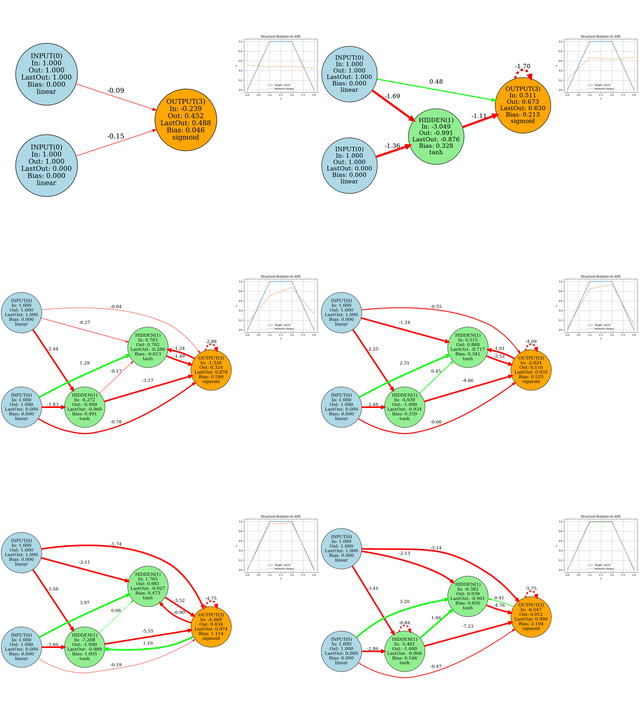
Start from a minimal network and grow its topology through structural mutation.
View examples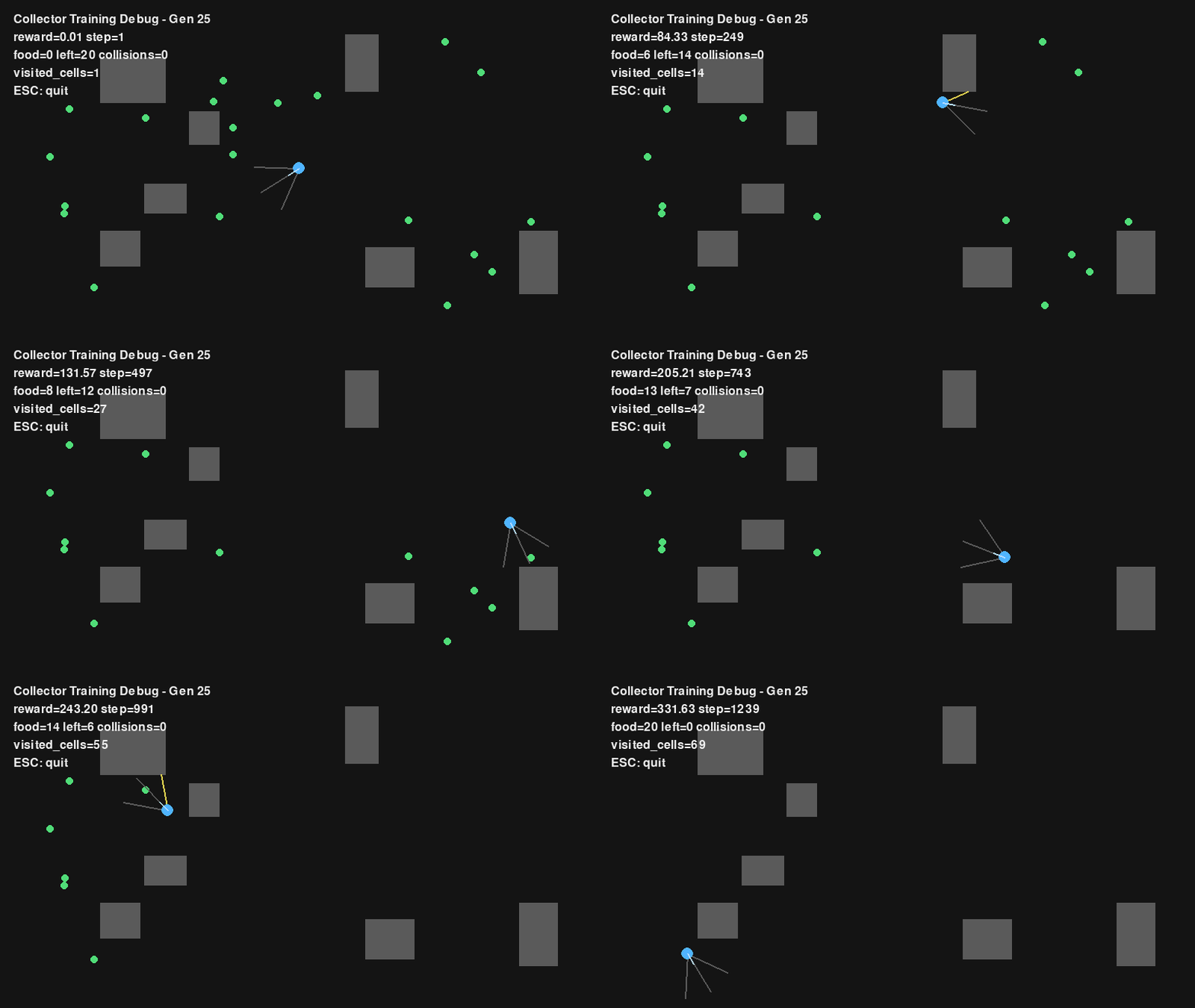
Evolve an agent that follows targets, explores the arena, and avoids obstacles.
View examples
Evolve support points to approximate a mathematical target.
View examplesHELI is an experimental neuroevolution mechanism implemented with EvoLib and EvoNet. Structurally mutated individuals are temporarily isolated in short-lived lineage populations before returning to global competition.
The repository contains the implementation, benchmark configuration, experiment scripts, and links to the archived paper and data.
View HELI research material
Optional integrations extend the core workflow with parallel
fitness evaluation and Gymnasium benchmark environments.
Optional Ray support can parallelize fitness evaluations. Sequential evaluation remains the default.
Install
pip install "evolib[parallel]"Configuration
parallel:
  backend: ray
  num_cpus: 8
The lightweight Gymnasium wrapper supports headless fitness
evaluation and GIF visualization for discrete and continuous
action spaces. The individual must contain a compatible
brain module.
Python
from evolib import GymEnv

env = GymEnv("LunarLander-v3", max_steps=500)

fitness = env.evaluate(indiv, module="brain")
gif_path = env.visualize(indiv, gen=10, module="brain")
Implementation, tests, examples, issues, and release history.
Sphinx documentation for configuration, APIs, and project components.
Published package metadata and installation files.
Examples ordered from basic evolution to EvoNet, Gymnasium, and EvoEnv.